Is there excess skin?
I assess how much skin is genuinely available to remove, its elasticity, and the position of the lower lid. A visible crease does not automatically mean that more skin should be taken away.
Understand your under-eye bags, skin, and hollows—and the plan each may need.
Schedule my consultation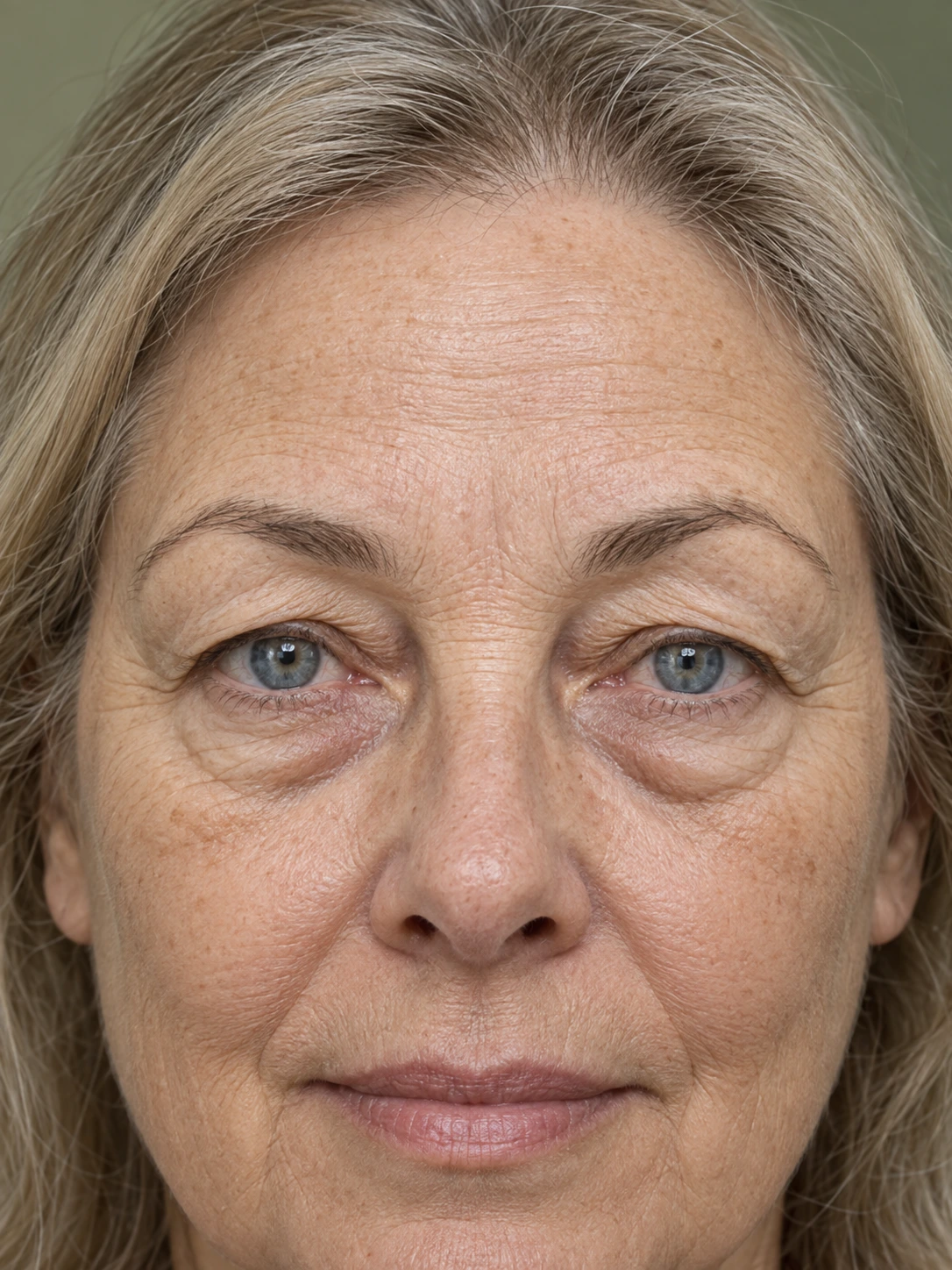
At a glance
Lower blepharoplasty is surgery to address selected changes in the lower eyelids, including excess skin and prominent fat bags. A hollow beneath the eye is assessed separately and may lead to a discussion of fat grafting. The plan should preserve eyelid position and function; it is not a universal treatment for dark circles.
You may feel rested and still see a heavy shadow beneath your eyes. Perhaps it is most noticeable in photographs, or people keep asking whether you slept well. Before proposing an operation, I want to understand exactly what you are seeing. A projecting bag, a hollow beneath it, and loose skin can create a similar impression while requiring different decisions.
My goal is not to erase every line around your eyes. It is to identify changes we can address while respecting the shape of your eyes and the way your eyelids work. That includes knowing when removing tissue would add a problem rather than solve one.
Lower blepharoplasty planning begins with an examination, not a photograph labeled with a technique. Pictures are helpful for an initial conversation from abroad, but they cannot fully show eyelid support, eye closure, or the condition of the eye surface.
I assess how much skin is genuinely available to remove, its elasticity, and the position of the lower lid. A visible crease does not automatically mean that more skin should be taken away.
Fullness can come from the fat compartments beneath the eye. If treatment is appropriate, the amount and route of access need to be planned conservatively, rather than aiming to remove as much fat as possible.
A depression at the eyelid–cheek junction is a separate concern. Reducing a projecting bag does not necessarily fill the hollow beneath it. Selected patients may benefit from fat grafting as part of the plan.
These questions are connected, but they are not interchangeable. The fourth consideration throughout is support: even an eyelid with little excess skin needs careful assessment of its position and function.
When skin removal is indicated, I may use a skin-pinch assessment to identify a narrow amount of excess before removing it. The purpose is to avoid treating the eyelid as skin that can simply be pulled tight. The amount that can be safely removed depends on the individual examination, especially after previous eyelid surgery.
Two terms are useful here. Scleral show describes visible white beneath the iris; ectropion means the eyelid turns outward. They are different findings, although both matter when discussing lower-lid position. A pinch technique does not make these risks disappear.
Kim and Bucky reported 71 patients, many of whom had other procedures at the same time; some developed temporary scleral show.[1] It is a useful reference, not proof that a skin pinch prevents complications. I use evidence to inform decisions, alongside the condition of the tissues in front of me.
If you have already had blepharoplasty, please tell me what was done and bring any available records. Sometimes the appropriate choice is to remove only a very small strip of skin; sometimes it is to remove none.
Tell my team what bothers you and where you will be traveling from. We can help arrange a consultation and explain how the assessment and follow-up are organized.
It is easy to look at an under-eye shadow and assume that everything in that area needs to be reduced. In reality, the shadow may sit just below a prominent bag. Removing too much tissue can leave the transition looking more hollow rather than more rested.
For fat bags, access may be through the inside of the eyelid, called a transconjunctival approach, or through an external incision. In selected cases involving a skin pinch, the planned incision can also provide access to the bags. The choice depends on the combination of findings, not on a claim that one approach is always best.
The internal approach is particularly relevant when bags are present without skin that needs removal. You can read about its specific role on the transconjunctival blepharoplasty page. This page considers the broader lower-eyelid plan, including skin and hollows.
Lower-eyelid skin is delicate, so small irregularities can be noticeable. In my practice, I prefer nanofat for selected under-eye hollows because of the contour improvements I have observed. I am particularly cautious about visible fullness or irregularity from larger fat particles in this region. That is my clinical preference; it is not a claim that every microfat technique produces an unfavorable result.
The distinction between observation and research matters. In Tonnard and colleagues’ original nanofat study, the processed sample contained no viable mature fat cells, and the clinical work focused on skin-quality applications.[2] It does not establish reliable long-term structural filling of a hollow, or prove that nanofat is superior to microfat for that purpose.
I explain this limitation when discussing my approach. Early postoperative fullness also includes swelling and cannot be used to measure lasting correction. Follow-up matters more than an immediate photograph. You can explore the broader subject on the facial fat grafting page.
A projecting contour can cast a shadow. Treating the contour may change the shadow, but does not necessarily change skin color.
A depression can look dark under certain lighting. The question is whether adding carefully selected treatment for that depression belongs in the plan.
Pigmentation and the appearance of vessels through thin skin are different from loose skin or a fat bag. Surgery should not be sold as a universal solution to dark circles.
Tell me if the appearance varies considerably from day to day. Fluctuating puffiness deserves assessment rather than an assumption that it is all excess fat. Our discussion should distinguish what an operation may improve from what needs a different evaluation.
Rosana shares her experience with blepharoplasty in the video below. Hearing a patient describe the process can help you think about the questions you want to bring to your own consultation.
Her account covers blepharoplasty as a whole rather than lower-eyelid surgery specifically; your plan depends on your own examination. The useful next step is to connect what interests you in her account with your own concerns.
Rosana shares her experience with blepharoplasty.
Please provide your medication and supplement list. Do not stop prescribed blood thinners or other medicines on the basis of a general website instruction. Any change must be coordinated with the professionals responsible for your care.
For patients outside Brazil, a video consultation can start this conversation and help organize the next steps. The surgical plan still requires an in-person assessment before surgery. That distinction should be clear before you make travel commitments.
Lower blepharoplasty can be considered alongside upper-eyelid surgery, a brow procedure, or a deep plane facelift when the findings justify it. These are separate decisions, not a standard package that everyone needs.
For example, a concern above the eye may involve the upper eyelid, the brow, or both. A lower-lid operation should not be expected to solve that concern. Equally, having a facelift does not automatically mean that skin should be removed from the lower eyelids.
A retrospective study of 892 blepharoplasty cases examined dry-eye symptoms and swelling of the conjunctiva, including associations with operative factors.[3] Such research supports a careful discussion of combined treatment; it does not provide a personalized risk estimate or prove that every combination is appropriate.
Swelling, bruising, and temporary differences between the two sides can make the early appearance difficult to judge. Dryness, a gritty feeling, or tearing should be reported so that we can assess what is happening and guide care. Do not assume that every new symptom is simply normal healing.
You will receive instructions suited to your procedure about hygiene, prescribed products, protection, and activity. If a transconjunctival approach is used, my instructions include avoiding contact lenses for two weeks, with resumption dependent on healing and symptoms. Bring glasses and discuss this in advance if you rely on contacts.
When lower blepharoplasty is combined with a facelift, recovery planning follows the combined operation. A short description of isolated eyelid surgery should not be used to decide when you can return to work, exercise, or travel after a larger procedure.
If you are traveling to Londrina from another country, arrange the local follow-up schedule before booking your return. The stay required for an isolated eyelid procedure should be determined for your case; it should not be inferred from our facelift timeline. The patient journey explains how we organize care for people coming from abroad.
Lower blepharoplasty can involve bleeding, infection, scarring, asymmetry, dry eyes, difficulty with eye closure, or a change in lower-lid position. Further treatment or revision may be needed. Rare but serious problems can affect vision.[4] Careful planning reduces avoidable risk but cannot promise a complication-free operation.
Severe or increasing pain, reduced vision, or rapidly increasing swelling on one side require urgent medical assessment. Do not wait for a routine follow-up or a WhatsApp response before seeking emergency care. We will explain how to contact the team and obtain help during your stay.
I want you to feel comfortable asking about these issues before surgery. Understanding the limits and the recovery is part of choosing treatment with confidence, not something to postpone until after you have booked.
No. A shadow caused by contour differs from pigmentation or visible vessels. I assess the cause before explaining what surgery may and may not improve.
No. When there is no excess skin that needs removal, an internal approach may be appropriate, subject to assessment of eyelid support and other findings.
It is a way of assessing and treating selected skin excess, not a guarantee against changes in eyelid position. Previous surgery and tissue support remain important.
I prefer it in selected cases based on the delicate contour I have observed in my practice. The published evidence does not establish superior or predictable long-term structural filling compared with microfat.
A previous operation changes the assessment. I need to examine remaining skin, scars, support, and symptoms. Sometimes little or no further skin removal is appropriate.
A video consultation helps us begin the assessment and organize your visit from abroad. The final surgical plan requires an in-person examination before the operation.
A thoughtful lower-eyelid plan starts by distinguishing what should be treated from what should be preserved.
These sources support the general information on this page. Descriptions of my practice explain how my team works; your surgical instructions will be individualized.