Lip lift
A lip lift removes skin according to a surgical plan. It can bring more of the upper lip into view by changing the relationship between the nasal base and the lip. It leaves a scar and cannot be treated as a reversible trial.
When your upper lip seems less visible, adding volume may not be the change you are looking for. I assess the relationship between your nose, lip, and smile to understand whether a lip lift could contribute to your facelift plan.
Schedule my consultation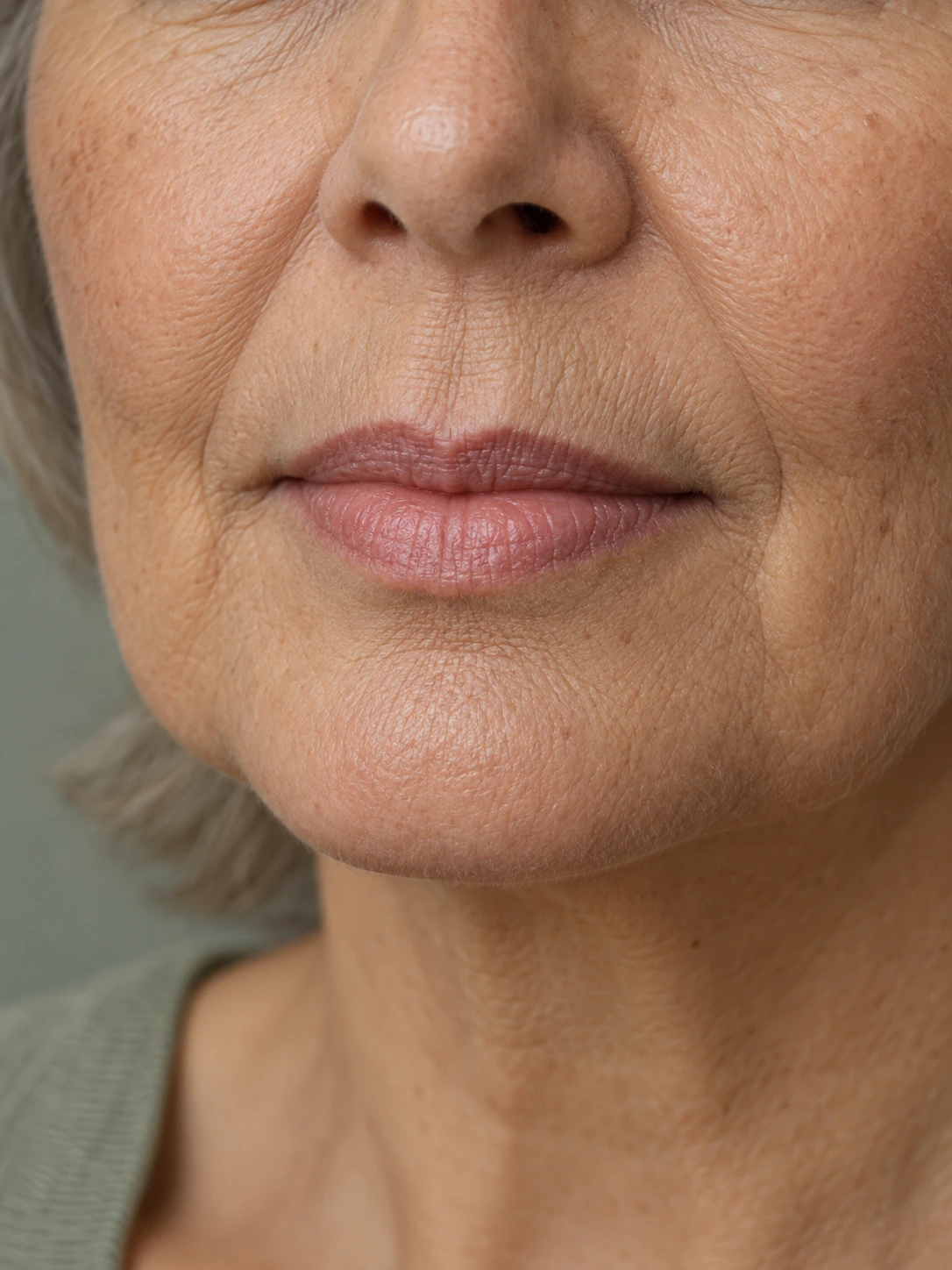
Illustrative image; not a patient or surgical result.
At a glance
A lip lift is surgery that removes a planned strip of skin beneath the nose to shorten the skin portion of the upper lip and increase visible vermilion in selected patients. It changes proportion rather than injecting volume. In my practice, I consider a subnasal lip lift only as an adjunct to a facelift, not as a standalone procedure.
Perhaps your upper lip seems to turn inward, or the red part appears less visible than it used to. You may notice less of your upper teeth when you smile, or feel that the space beneath your nose has become more prominent. These observations are useful starting points, but they do not establish that a lip lift is appropriate.
I want to understand the change you would like to see. A wish for a fuller lip can mean more volume, more visible vermilion, a different relationship with the teeth, or simply a less tired expression. Those goals are not interchangeable. We need to identify which one matters to you before discussing an operation.
The consultation includes movement. A still photograph may not reveal how your lip behaves when you speak, smile, or close your mouth. I also ask about previous fillers and surgery, because they can affect the appearance we are examining and the decisions that follow.
A lip lift removes skin according to a surgical plan. It can bring more of the upper lip into view by changing the relationship between the nasal base and the lip. It leaves a scar and cannot be treated as a reversible trial.
An injectable filler adds material to alter volume or contour. It is not the same as shortening the skin above the lip. I do not perform injectable filler treatments in my practice; this comparison is here to clarify the different goals, not to offer a package of treatments.
A lip flip uses botulinum toxin to temporarily affect muscle activity around the upper lip. It does not remove skin. Its scope and risks differ from those of a lip lift, so a subtle temporary change should not be presented as equivalent to a structural operation.
I consider lip lift within a deep plane facelift plan when the upper lip has its own indication for treatment. A facelift does not automatically shorten the skin between the nose and upper lip. Equally, having a facelift does not mean you need a lip lift. Each component needs a reason.
I examine the nasal base, upper-lip border, tooth display, and ease of lip closure. I look at the relationship between the upper and lower lips and the rest of your face. A naturally short upper lip or pronounced tooth and gum exposure needs particular caution, because additional shortening may create a change you do not want.
The amount of skin to remove is not selected from a standard number on the internet. Your starting anatomy and the desired change matter more than matching a particular measurement. I prefer to explain the proposed adjustment clearly before it becomes a surgical marking, including what the operation will leave unchanged.
Let us discuss your smile, upper-lip proportion, and the scar before deciding whether to include this procedure.
The subnasal design I use follows the region beneath the nose and is commonly called a bullhorn lip lift. A planned strip of skin is removed, and the closure brings the upper lip into a different relationship with the nasal base. This is a small area of the face, but it is also a highly visible one.
Placing the incision near a natural junction may help make the scar less conspicuous. It does not make it invisible. Skin characteristics, the shape of the nasal base, healing, and the final tension of the tissues all matter. A raised, widened, or otherwise noticeable scar remains possible even with careful planning.
We discuss that tradeoff before surgery. If the expected change in proportion is small but the scar would be unacceptable to you, proceeding may not be the right choice. The question is not whether another person's photograph looks attractive; it is whether the likely benefit and the commitments of surgery fit your own face and priorities.
You use your lips to speak, eat, smile, and close your mouth comfortably. Those functions belong in the aesthetic discussion. The intended result should not depend on constantly holding your mouth in a particular position for photographs.
Removing too much skin can be difficult to correct. It may produce unwanted tooth display, an unnatural appearance, or trouble bringing the lips together. A conservative, individualized plan is therefore more useful than a universal claim about how many millimeters create an ideal lip.
Existing asymmetry also matters. I point out differences before surgery so they do not become an unexpected discovery afterward. The goal is an appropriate change in proportion, not a promise of perfect symmetry or a standardized smile. Choosing not to add a lip lift is a valid outcome of this assessment.
A systematic review by Alves Júnior and colleagues selected four studies on subnasal lip lift: two retrospective cohorts and two case series. The studies reported aesthetic improvement and maintenance over follow-up periods ranging from 12 to 59.1 months. Most participants were women. These findings support discussing a potential benefit, but they do not establish a guaranteed result for every patient or lifelong stability. 1
Another systematic review, published in 2023, included nine articles, eight concerning surgical procedures and one concerning a nonsurgical approach. It found that surgical methods appeared to have a longer-lasting lifting effect, with the tradeoff of a scar. The authors also highlighted inconsistent ways of measuring the change, which limits straightforward comparisons. 2
For your decision, the useful distinction is between a structural change and a permanent aesthetic promise. Surgery removes skin, but aging continues and the appearance can evolve. I assess the result through proportion, expression, function, and scar development rather than calling an early postoperative photograph the final outcome.
Tell me about previous lip or nasal procedures, fillers, cold sores, smoking, and any history of difficult healing. Bring a complete medication list, including supplements. These details can affect preparation and may change whether or when the procedure should be performed.
Do not stop prescribed medication or begin preventive medication from a general website schedule. Your instructions need to reflect your health, the complete operation, and the professionals involved in your care. A previous episode of cold sores, for example, is something to discuss in the consultation rather than a reason to follow someone else's prescription.
Because I perform lip lift with a facelift, the preparation, hospital arrangements, and recovery plan concern the combined surgery. The patient journey explains how consultation, testing, preparation, and follow-up connect. Before the operation, you should know whom to contact if a new symptom or question affects those plans.
Early swelling and a feeling of tension can make speaking and eating less comfortable. You receive guidance on hygiene, food consistency, and care of the incision for your specific operation. It is important to plan around the recovery of the whole surgical combination, not the shortest downtime quoted for an isolated lip procedure.
Follow-up allows us to assess wound closure, review stitches, and adapt care as healing progresses. Do not try to accelerate the process by stretching your smile, testing maximum mouth opening, massaging the incision, or adding products without instructions. Daily comparisons with an expected final appearance can be misleading while swelling changes.
The scar may initially look red, raised, or firm. Its appearance evolves over months, and the course differs between patients. We discuss when makeup, scar care, and ordinary activities can be resumed according to healing. A fixed date on a website should not replace the assessment of your incision.
Possible problems include an unfavorable scar, asymmetry, infection, wound separation, altered sensation, and unwanted changes in tooth display or the nasal-base region. The lift may be insufficient or excessive, and revision may sometimes be needed. No description of the procedure should promise that the nose cannot look different afterward or that lip function cannot be affected.
Persistent difficulty closing your mouth needs assessment rather than dismissal as a cosmetic detail. Increasing pain, discharge, fever, or a marked change in skin color should also prompt contact with the team for evaluation. If symptoms are severe or you need urgent care, do not wait for a routine appointment or a remote reply.
Knowing these possibilities does not require you to become an expert in surgery. It gives you a clearer basis for deciding whether the change you want is worth the scar, the recovery, and the uncertainty involved. If that balance is not favorable, declining the lip lift is a reasonable choice.
A video consultation can help us understand your goals and discuss preliminary plans. The final decision and examination must take place in person before surgery. Photos are useful, but they do not replace seeing the upper lip at rest and in motion.
For our facelift patients, the travel plan is to arrive two days before surgery and remain at least 12 days afterward, preferably 14. Those intervals support preparation and follow-up; they are not automatic clearance to fly. Your recovery may require a different arrangement, which is why return travel should be discussed with the team rather than assumed in advance.
Our team can help with practical questions about accommodation, transport, and support during your stay in Londrina. Make sure the plan includes your postoperative appointments and how you will obtain care after returning home. Remote follow-up is useful, but a problem needing examination must be assessed where you are.
No. I consider it as part of a facelift plan when the upper lip has a specific indication. This page explains that service rather than offering an isolated lip-lift operation.
It may make more vermilion visible, but it does not inject volume. If the concern is primarily the thickness of the lip, that distinction needs to be discussed before choosing surgery.
No scar can be promised to disappear. It may become less noticeable as it matures, but healing varies and an unfavorable scar remains possible. Its location beneath the nose is part of the tradeoff, not a guarantee of invisibility.
The operation produces a structural change, but that does not mean your appearance stays fixed for life. Aging continues, healing varies, and research follow-up does not justify a lifetime guarantee of proportion or satisfaction.
A measurement alone is not enough. I examine the relationship between your nose, lip, teeth, and facial proportions at rest and in motion, then relate those findings to the change you want.
Yes, particularly if too much skin is removed or the operation does not fit the anatomy. That is why the plan considers tooth display, smile, and lip closure rather than simply aiming for a shorter distance.
Bring the detail that bothers you and the questions you want answered. I will assess whether a lip lift adds a meaningful benefit to your facelift plan and explain the scar and recovery before you decide.
These sources support the general information on this page. Descriptions of my practice explain how my team works; your surgical instructions will be individualized.