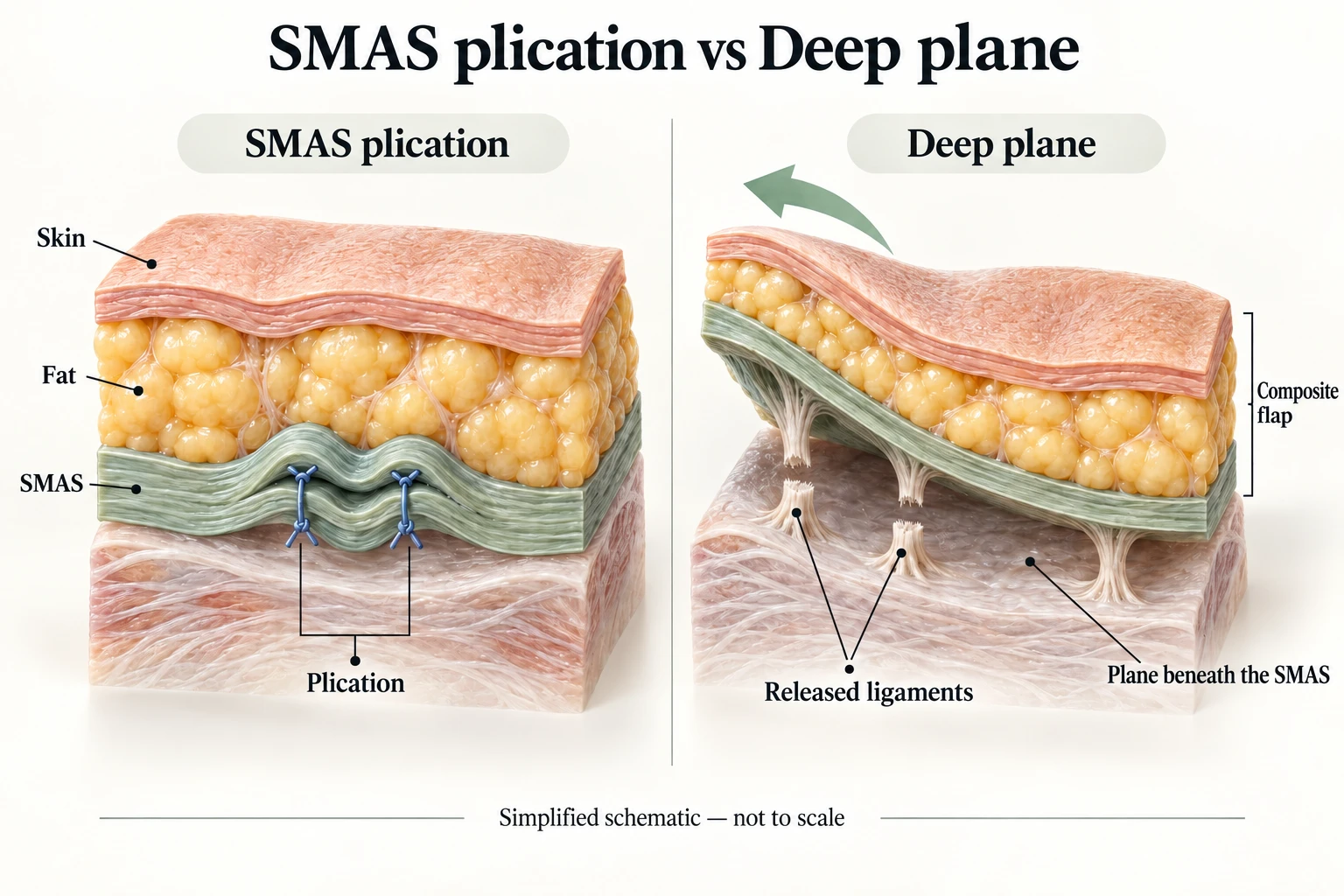
Plication
Plication uses stitches to fold and adjust the SMAS. It does not involve the same pattern of ligament release as a deep plane operation. This is a specific approach, not a description of every surgery that includes SMAS treatment.
Compare the surgical plan, not just the name attached to it.
Schedule my consultation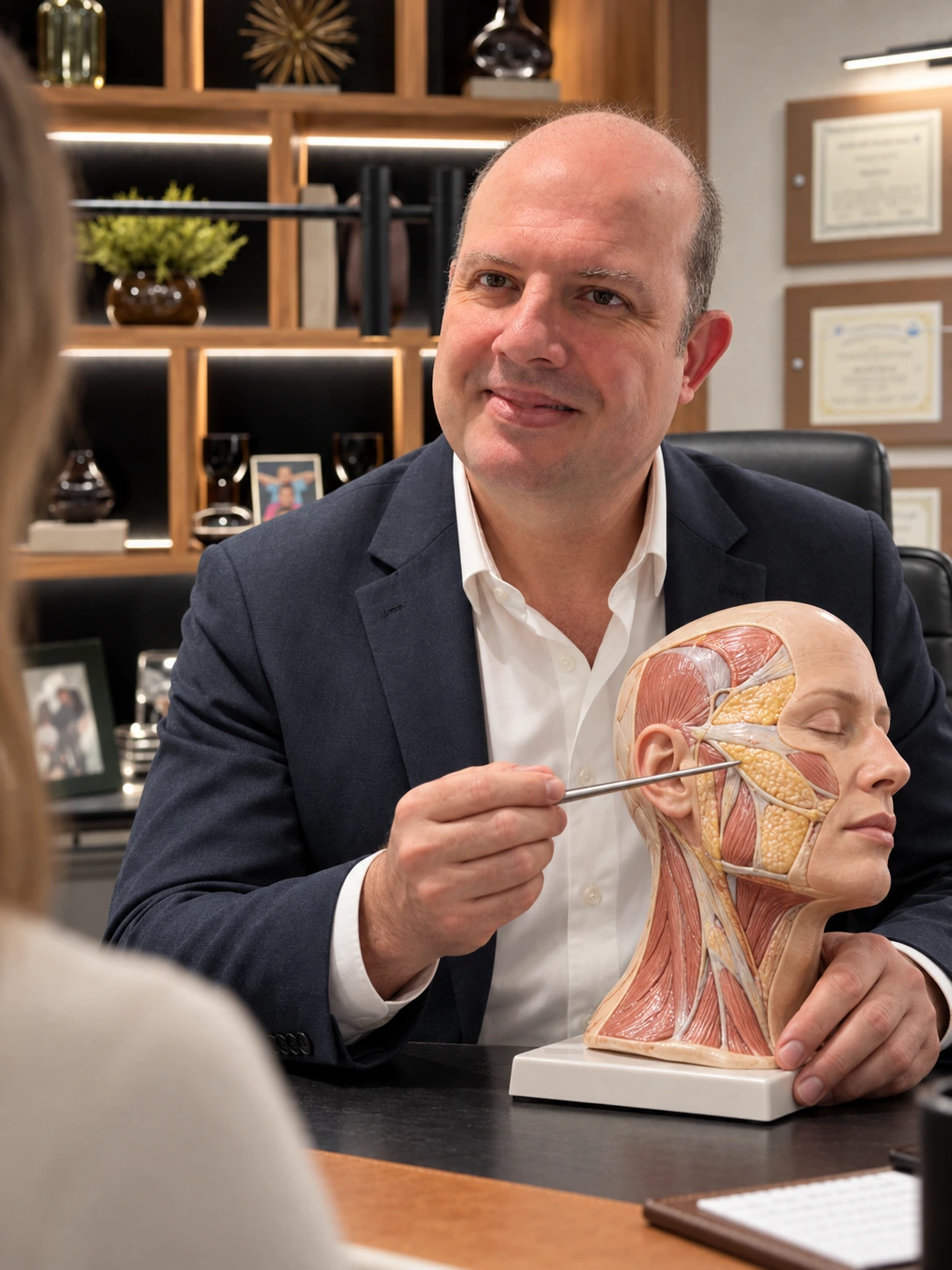
Illustrative image.
At a glance
SMAS stands for superficial musculoaponeurotic system, a tissue layer involved in facial support. Surgeons can treat it in different ways, including folding and suturing it, removing a strip, or raising a flap. A deep plane facelift works in the plane beneath this layer, releases selected retaining ligaments, and repositions the SMAS together with the overlying fat and skin. It therefore also involves the SMAS. The useful comparison is between specific operations, not between using the SMAS and avoiding it.
You may have read one surgeon describing deep plane as essential and another showing appealing results with a different approach. That can leave you feeling responsible for choosing a surgical method before anyone has examined you.
I want to start somewhere more useful: what has changed in your face, what bothers you, and what you want to preserve. A heavier lower face, a less defined neck, and loss of facial volume do not all ask the same thing of an operation. Naming the technique does not replace identifying those concerns.
If you have already received another proposal, bring it to our discussion. We can compare which regions are being treated, which additional procedures are included, and how recovery will be managed. You should not need a medical vocabulary to understand why I recommend a particular plan.
Plication uses stitches to fold and adjust the SMAS. It does not involve the same pattern of ligament release as a deep plane operation. This is a specific approach, not a description of every surgery that includes SMAS treatment.
A SMASectomy removes a strip of this tissue and closes the resulting edges with sutures. The extent and direction of the adjustment matter. The word alone does not describe the full treatment of the face and neck.
Other techniques mobilize a flap of the SMAS. There are variations in dissection and repositioning, so calling every non-deep-plane facelift superficial or skin-only is misleading. Ask which approach is actually being proposed rather than assuming that all operations under the SMAS label are alike.
In a deep plane facelift, I work beneath the SMAS and release selected points of attachment so that tissues can be repositioned. The extent of the release, the direction of movement, fixation, and treatment of the neck all contribute to the operative plan.
This approach is central to my practice. I value planning around tissue support and the relationship between facial regions while preserving the features that make you recognizable. That explains my preference; it is not proof that every deep plane operation is better than every alternative for every patient.
The main facelift guide describes the broader operation. On this page, I want to help you interpret competing descriptions. An explanation that connects the technique to your own face is more valuable than being told that one label automatically produces a natural result.
Bring your questions and previous proposals. I can explain how the technique relates to your anatomy and the change you hope to see.
Ask the surgeon to identify what will be repositioned and what falls outside the operation. A treatment focused on the lower face is not necessarily equivalent to a plan that also includes the neck or eyelids. Two proposals can use the same title while addressing different concerns.
The facial technique does not, by itself, specify treatment of neck skin, the platysma, or deeper fullness beneath the chin. I consider deep neck treatment only with a facelift in my practice. Whether it is appropriate, and which structures require attention, depends on the examination.
Repositioning tissue and adding volume are different decisions. A photograph showing a facelift with fat grafting does not demonstrate the effect of the lift alone. Ask what each proposed addition is intended to change and what it cannot promise.
Clarify the hospital arrangements, office reviews, contact process, and plan if a complication occurs. For someone traveling to Brazil, that also means knowing how long to stay and how follow-up will continue after returning home. Those details belong in the comparison, even if they are less prominent in advertising.
A 2025 review by Vayalapra and colleagues included 47 studies and 10,766 patients. It found improvement with both SMAS and deep approaches, but direct aesthetic comparisons were limited and outcome measures differed. A large total number of patients does not remove those methodological limitations. 1
Khoury and colleagues published another review in 2025, including 21 studies and 2,896 patients. Their analysis pooled results from separate series using a one-arm meta-analysis. Differences between pooled satisfaction figures cannot establish that the technique itself caused the difference; the patients, surgeons, procedures, and assessments were not interchangeable. 2
In 2026, Neel and colleagues reported a prospective cohort of 166 primary facelifts, with 45 deep plane and 121 SMAS plication cases. They found no significant differences in the reported early outcomes, but median follow-up was only three months. Unequal group sizes and the absence of validated outcome instruments were additional limitations. Three-month findings cannot answer which approach lasts longer over years. 3
I use these studies to keep the consultation grounded. They support a discussion of options and uncertainty, rather than a universal ranking. A review's overall complication rate also is not a personalized estimate for the patient sitting in front of me.
When someone says they are afraid of looking pulled, I ask what that means to them. It may be an unfamiliar mouth shape, a change around the ears, too much volume, or a face that no longer feels like their own. Those concerns deserve a specific discussion.
The final position of the tissues, skin tension, proportions, and any added volume all belong in that conversation. I do not attribute an artificial appearance to the word SMAS or promise its absence because the operation is called deep plane.
When reviewing cases with you, I explain which procedures were combined and when photographs were taken. Lighting, pose, and the stage of healing affect how an image is read. You can also bring earlier photographs of yourself to help describe preferences, without treating them as a promise to recreate an exact age or appearance.
I do not give an individual result a guaranteed expiration date. Aging continues after surgery, and changes in skin, weight, and tissues can affect appearance. A technique name cannot specify what your face will look like a decade later.
It is also important to ask what a study means by a lasting result. Satisfaction after more than a year and a standardized comparison of facial changes over many years are not the same measure. An early photograph cannot establish long-term superiority, even when the initial change looks impressive. 2, 3
A more useful consultation question is what improvement we expect in your anatomy, what will remain, and how we will assess progress. I can discuss those expectations without turning uncertainty into a fixed number of years.
Bleeding or hematoma, changes in sensation, nerve injury affecting movement, healing problems, asymmetry, and the possibility of revision all need discussion. Comparative reviews use different definitions and follow-up methods, so I do not take one percentage from a pooled analysis and present it as your personal forecast. 1, 2
I also do not equate deeper with automatically safer or more dangerous. Your health, medications, smoking or nicotine use, previous procedures, and the scope of the operation influence planning. Never stop a prescribed medicine based on a general facelift comparison; medication decisions need to account for why you take it.
The facelift risk guide explains warning signs and how urgent assessment differs from routine follow-up.
Recovery follows the combined operation. In my practice, we commonly discuss a social return around two weeks, but that is not the final result or permission for every activity. The patient journey explains how the early appointments and longer follow-up fit together.
The name of your previous technique is useful information, but it is not the whole history. I need to assess the current tissues, scars, areas of concern, and any persistent symptoms before proposing another procedure.
A deep plane revision may be considered after another type of lift, but I cannot confirm the plan solely from a photograph. Bring available operative information and explain what you liked about the first result, what changed with time, and what you would like addressed now.
The revision facelift guide discusses this more fully. Prior surgery is a reason for individualized assessment, not an automatic argument that the first technique was wrong or that changing its name guarantees a better result.
Before choosing dates, ask for clarity about the consultation, hospital, anesthesia, associated procedures, and follow-up. A quote for a different combination of treatments is not a like-for-like comparison merely because both documents say facelift.
Our usual travel planning is arrival two days before surgery and at least 12 days afterward, preferably 14. The in-person examination confirms the plan before surgery. Permission to fly depends on your recovery and travel circumstances, not just the calendar.
Use the contact page to begin that discussion from abroad. I would rather resolve a mismatch in expectations before travel than let the decision depend on a photograph, a headline, or the assumption that every operation carrying a particular name is identical.
Yes. It works beneath this layer and includes it in the mobilized tissues. The comparison is between ways of treating and releasing tissue, not between an operation with SMAS and one without it.
No. Different SMAS approaches can produce natural-looking results. The plan, execution, anatomy, and associated procedures matter. I do not use an unflattering result to dismiss every operation under one broad label.
I do not promise a shorter recovery based on the name alone. Your combined procedures and individual healing matter. The 2026 comparative cohort did not show a significant recovery difference, and its short follow-up limits broader conclusions.
No. Tell my team what concerns you and what you hope to change. We can discuss the approach during assessment. Understanding the explanation is important; arriving with a self-selected operation is not a requirement.
No. It describes how I approach facelift surgery in my practice. A consultation still needs to establish whether surgery is appropriate for you, what it would involve, and whether the expected change fits your priorities.
Bring your questions and any previous proposals. I will explain what I would treat, why I recommend that approach, and which limitations remain. The goal is for you to understand the decision in relation to your face, rather than feel pressured to choose the winning name in an online debate.
These sources support the general information on this page. Descriptions of my practice explain how my team works; your surgical instructions will be individualized.