At a glance
Skincare and facelift surgery address different concerns. Moisturizing and selected dermatologic treatments can improve aspects of skin appearance, but a cosmetic cream does not surgically reposition facial tissues.12 When I assess your concerns, I distinguish surface texture, color, volume, and contour. Disappointment with a product does not establish a reason to operate. A consultation may lead to dermatologic care, observation, or a discussion of surgery. After a facelift, skincare still has a role, but restarting products needs to fit your recovery instructions.
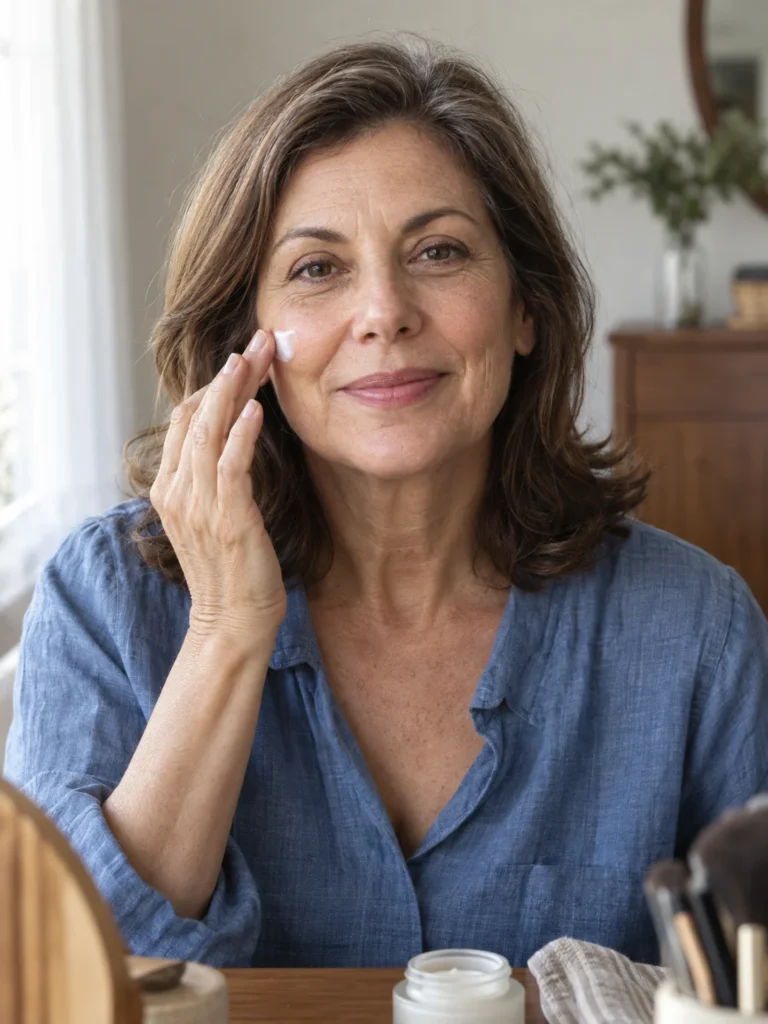
Hero image: an AI-generated illustration, not a patient photograph or a surgical result.
Your skincare may be helping, even if the jawline has not changed
Perhaps your skin feels more comfortable and makeup sits better, yet the lower face still looks heavier than you would like. That does not necessarily mean your routine has failed. You may be noticing two different features and expecting one treatment to address both.
I find it helpful when you explain the contrast in your own words. You do not need to know which anatomical layer is involved. Pointing to the area and describing what bothers you gives us a starting point for examination and discussion.
The reverse situation matters too. You may be considering a facelift mainly because you want fewer visible pores, more even pigmentation, or smoother fine lines. I need to explain where those expectations differ from what repositioning tissues is intended to accomplish. Surgery should not be selected simply because it sounds like the most comprehensive option.
Four questions hidden inside the word rejuvenation
Is the concern at the skin surface?
Dryness, roughness, and fine lines may be what draws your attention. Tell me how the skin feels, whether the appearance varies, and what treatments you have already tried. A surface concern deserves assessment on its own terms; it does not automatically indicate a facelift.
Is it a change in color?
A spot or area of uneven pigmentation should not simply be labeled aging and assigned to surgery. Tell me whether a dermatologist has examined it and whether you have a diagnosis. Moving facial tissues is not a substitute for evaluating a skin change.
Is an area looking hollow?
Volume is a different question from hydration. If your concern is a hollow-looking area, I assess it in relation to the surrounding face rather than assuming that a richer moisturizer or a larger surgical lift is the answer. Your history and examination help distinguish the options and their limits.
Has the outline of the face changed?
If you point to the cheeks, jawline, or neck, I consider the overall anatomy rather than attributing everything to the skin. A photograph can help begin a conversation, particularly when you live abroad, but it cannot determine the complete treatment plan on its own.
What a skincare study actually measures
The word improvement needs an object. Improvement in fine wrinkles is not the same outcome as a change in jawline shape. A study of pigmentation does not prove that a product elevates a cheek. I want the benefit being discussed to match the concern you are trying to address.
A 2025 systematic review and meta-analysis included eight randomized trials with 1,361 participants comparing topical tretinoin with its vehicle formulation. The findings supported improvement in wrinkles associated with photodamage. Follow-up across the trials ranged from 16 weeks to two years.2
Those results do not compare a cream with facelift surgery. They also do not apply automatically to every product described as anti-aging. The included trials were published between 1988 and 2006, used different formulations and assessment methods, and the review identified possible publication bias for fine-wrinkle outcomes. A recent review date does not make all the underlying experiments recent.2
For your decision, this distinction is useful: a treatment may have evidence for a particular skin feature without offering the contour change you hoped for. That is a reason to clarify the goal, not to dismiss skincare as worthless or to move directly to an operation.
A research result is not a prescription
The same review found more adverse effects with tretinoin, including irritation.2 I am not providing a concentration, frequency, or combination of products here. Your skin condition and the advice of the clinician treating it need to guide those choices.
The American Academy of Dermatology distinguishes retinol from prescription retinoids such as tretinoin and discusses individual suitability, irritation, and pregnancy precautions.3 Products from the same broad family are not automatically interchangeable. If you are pregnant or planning pregnancy, discuss your products with the responsible clinician before starting or continuing a retinoid.
For our consultation, bring the names or photographs of products you actually use. Include prescribed treatments and anything that caused a reaction. There is no need to purchase a more elaborate routine to prepare for meeting me, and increasing the number of active ingredients is not a measure of readiness for surgery.
Looking after the skin remains worthwhile
Sun protection and moisturizing have their own place in care. The AAD includes these among its public recommendations for addressing visible skin aging and cautions that excessive use of products can irritate skin.4 A useful skin-care habit does not need to produce a surgical effect to justify keeping it.
I do not want you to abandon well-guided dermatologic care because you are exploring a facelift. Nor do I want you to interpret a full bathroom cabinet as proof that every nonsurgical possibility has been exhausted. The issue is whether the care is suitable for the concern, not how much time or money it has consumed.
If your dermatologist is in your home country, let me know what is being treated and what instructions you have received. Coordinating information is more useful than leaving you to resolve apparently conflicting advice while preparing for international travel.
When does a facelift consultation make sense?
It can make sense when you want to understand a contour change and discuss the possibilities, without having decided to operate. I examine the face, listen to what you hope to change, and explain what surgery could reasonably address. Health, recovery requirements, and personal priorities belong in that discussion too.
If the concern involves tissue position and facial contour, I explain the approach described in the deep plane facelift overview. I do not present it as a universal treatment for spots, pores, fine lines, or every visible sign of aging. We need to identify what would remain outside the operation’s purpose.
A phrase such as “I want to look refreshed” can mean something different to each person. I may ask which area you notice first or what change would feel meaningful. Specific observations let us discuss a concrete goal instead of agreeing to a broad word with different expectations behind it.
The conclusion may be that surgery is not the right next step. There is no obligation to operate because a cream did not deliver what advertising led you to expect.
Why pulling the skin in a mirror is not a surgical preview
Moving the skin with your fingers can show where you would like a change, but it does not reproduce an operation or predict its result. I use that gesture as a way to understand your concern rather than as a sufficient basis for choosing a technique.
I also want to know about earlier procedures, including treatments that now seem minor or remote. What was done and when can help explain your present appearance. If you have records, bring them. This is a clinical history, not a comparison of which practitioner was right.
Older personal photographs can help you describe what you remember about your face. Lighting, angle, expression, and camera distance affect appearance, however. I do not promise to reproduce a photograph or make an earlier age the target of treatment.
Preparing for a consultation from abroad
Before deciding to travel, organize your questions around what you want to change, the treatments you have tried, and the time you can realistically allow for care. An online conversation can begin that process; the in-person evaluation remains important before surgery.
The patient journey explains how the steps fit together. I prefer to keep recovery and travel planning there rather than give a second, competing timetable in a skincare article. Neither a skincare improvement nor a comfortable early recovery establishes automatic clearance to fly.
If you are unsure whether the concern is mostly skin quality or contour, say so. You do not need to choose the operation’s name before asking for an assessment. That distinction is precisely something we should work through together.
Restarting products after surgery is a separate decision
After a facelift, the question includes the stage of healing and the area where a product would be applied. A familiar product is not automatically suitable for an incision or recently operated skin simply because you tolerated it before surgery.
I do not give a universal day for restarting acids or retinoids in this article. Ask specifically about the products you intend to use and follow the instructions of the team assessing your recovery. We may need to coordinate that advice with your dermatologist.
Burning or irritation should not be interpreted as evidence that a treatment is working harder. Report what happened, where it occurred, and which product preceded it. Do not continue experimenting in an attempt to accelerate the final appearance.
Stitch removal is also not a blanket authorization to restart every previous routine. Ask about the next step instead of assuming that one recovery milestone answers all product questions.
Questions worth bringing with you
- Is my main concern surface texture, pigmentation, volume, contour, or a combination?
- What could surgery change, and what would remain outside its purpose?
- Which current skin treatments should be discussed before an operation?
- How can my dermatologic care at home be coordinated with surgical follow-up in Brazil?
- If I decide not to operate, what expectations should I have of continuing skin care?
Frequently asked questions
Does a disappointing cream mean I need a facelift?
No. I first want to understand what you expected and which feature the product was intended to address. A disappointing purchase is not a surgical indication. The next step may be a dermatologic assessment, a different expectation, observation, or no new intervention.
Can good skincare guarantee that I will never consider surgery?
No single routine determines that decision. Skincare and surgery have different purposes, and a consistent routine neither obliges nor prevents you from operating. I assess the concern, anatomy, and health rather than treat either choice as a reward or failure.
Will a facelift replace my dermatologist?
No. If you have a skin condition or ongoing treatment, it remains relevant. I want that information included in preparation so the surgical and dermatologic instructions can make sense together.
Can I restart all my products once the stitches are out?
Do not use that milestone as blanket permission. Ask about the specific products and where you plan to apply them. The answer should reflect healing and the instructions from the team caring for you.
Let us clarify the change you are looking for
If you are caring for your skin but remain unsure about changes in facial contour, contact Bruna to arrange a consultation with me. We can discuss what you are noticing and whether a surgical assessment in Brazil fits your goals, without treating every concern as a reason to operate.
References
- American Academy of Dermatology. Many ways to firm sagging skin. Public guidance on the limitations of topical products; not a list of services offered by this practice.
- Huang HY, Lee LT. Tretinoin for Photodamaged Facial Skin: Systematic Review and Meta-Analysis of Randomized Controlled Trials. Dermatology Practical & Conceptual. 2025;15(4). DOI:10.5826/dpc.1504a5172.
- American Academy of Dermatology. Retinoid or retinol?. Public guidance on suitability and precautions; not an individual prescription.
- American Academy of Dermatology. Wrinkle remedies. General skin-care guidance.