Fat bags
The internal approach provides access to the fat contributing to lower-eyelid fullness. The compartments and the amount of treatment are assessed individually.
An internal approach to under-eye bags, chosen for the right anatomy.
Schedule my consultation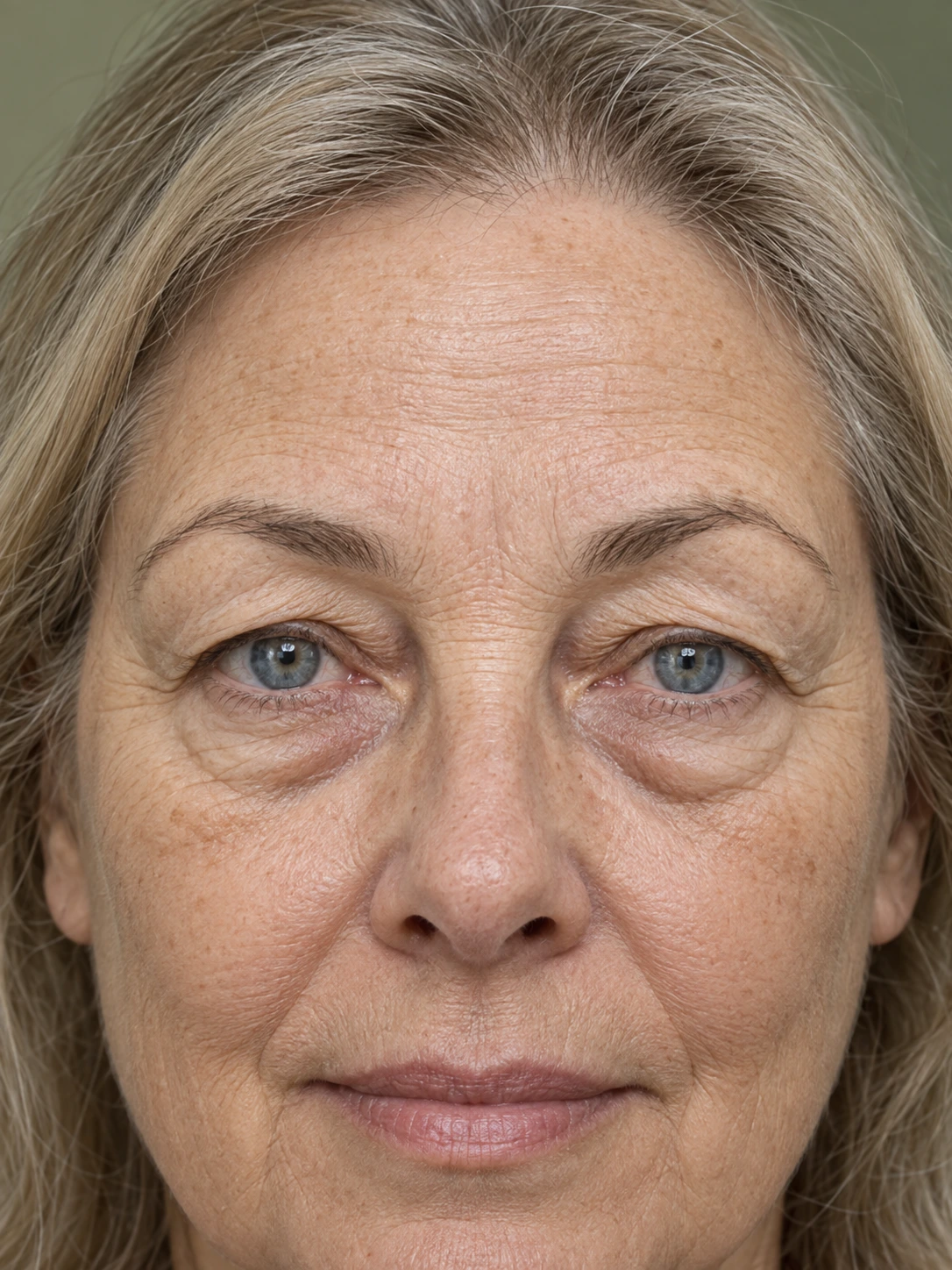
At a glance
Transconjunctival blepharoplasty accesses lower-eyelid fat through an incision in the conjunctiva, inside the eyelid. When performed alone, it does not require a skin incision. I consider it especially for bags without excess skin that needs removal, after assessing eyelid support, hollows, and eye health.
If bags beneath your eyes bother you, an operation without an incision in the skin may sound appealing. The first question is whether that approach addresses your actual concern. I need to assess the skin, the position and support of the lower lid, and the transition into the cheek before recommending it.
Age alone does not answer that question. Two people of the same age may need different plans, while similar-looking bags in photographs may have different features on examination. I am looking for the source of the fullness, not simply matching a picture to a procedure name.
I also want to know what a successful change would mean to you. My aim is to reduce an unwanted prominence while preserving a balanced contour. Removing the largest possible amount of fat can create a hollow appearance rather than the rested expression you had in mind.
The internal approach provides access to the fat contributing to lower-eyelid fullness. The compartments and the amount of treatment are assessed individually.
An internal incision alone does not remove skin. If skin treatment is needed, I may consider an additional skin pinch or another suitable approach.
A depression beside a bag does not necessarily disappear when the bag is reduced. Fat grafting may be a separate part of the discussion.
Pigmentation or visible vessels are different from projecting fat. Surgery for bags should not be presented as a solution to every kind of dark circle.
Understanding these differences helps you ask a useful question during consultation: which part of what I see will this operation actually address? A smaller incision is meaningful only if the plan fits the problem.
The conjunctiva lines the inner surface of the eyelid. Through an incision in that lining, I can reach the lower-eyelid fat without cutting the skin when this is the only procedure performed. It remains surgery close to delicate structures, with healing and follow-up requirements.
The lower lid has medial, central, and lateral fat compartments. The treatment is directed to the findings in each area and on each side. It is not a matter of removing identical amounts from every compartment or assuming that the two sides begin in exactly the same condition.
In the technique I use, the conjunctival edges are left together without sutures. Healing develops over the following days. This does not mean the incision should be examined or manipulated at home. My team explains how to care for the area without disturbing it.
Anesthesia and operating time depend on the complete plan, particularly when other procedures are involved. I prefer to discuss those details after understanding what we intend to do, instead of promising a fixed duration before examining you.
Tell my team about your concern and where you will be traveling from. We can organize a consultation to discuss whether an internal approach fits your needs.
When transconjunctival blepharoplasty is performed alone, it does not create a skin incision. That can be useful when no skin needs to be removed. It does not mean there is no incision anywhere, no swelling, or no risk.
If I add a skin pinch, that skin removal involves an external incision. Upper-eyelid surgery has its own incisions as well. Ask about the whole operation rather than relying on the word “internal” to describe every part of it.
I do not use the absence of a skin incision to promise immediate return to work or zero risk of a change in eyelid position. The examination, careful tissue handling, and follow-up remain important whichever route is used to reach the fat.
Upper-eyelid surgery or a brow procedure may be considered when there is a separate concern in those areas. Removing eyelid skin does not automatically substitute for addressing the position of the brow. Each proposed step needs a reason you can understand.
For a hollow below the bags, I may discuss fat grafting. In selected under-eye hollows, my preference for nanofat reflects the contour I have observed in my practice. That observation should not be mistaken for proof that nanofat provides superior or predictable long-term structural volume. The lower blepharoplasty page explains this distinction and the evidence in more detail.
Transconjunctival treatment can also be part of a deep plane facelift plan when both are indicated. Recovery is then organized around the combined operation. Combining procedures is not an obligation or an automatic way to achieve a better result.
Please tell me about burning, redness, watering, dryness, the use of eye lubricants, or difficulty closing your eyes. Contact lenses, previous eye surgery, and ongoing ophthalmic care all matter. These details can influence the plan as much as the visible size of a bag.
Previous eyelid operations, fillers, and other treatments around the eyes also need to be discussed. Bring available reports, earlier photographs, and product names if you have them. An area that has already been treated may require a different assessment.
Include medications and supplements in the information you provide. Changes to prescribed treatment require individual instructions and, when appropriate, coordination with the prescribing doctor. Do not stop a medicine because you found it on a general online list.
If you live outside Brazil, we can begin with a video consultation. This helps us discuss your priorities and organize your visit to Londrina. I still confirm the surgical plan in person: a clear camera image does not replace examining eyelid support and the eye surface.
Swelling, bruising, irritation, and watering can occur after surgery. In my practice, some patients notice wetter eyes or a little fluid discharge early on, improving over about two or three days. That is an observation in some patients, not a deadline by which every symptom should disappear.
Chemosis means swelling of the conjunctiva. It is not another name for all tearing, and discomfort should not automatically be attributed to normal healing. Persistent or worsening symptoms need assessment, especially when there is pain or a change in vision.
A 2024 study of 1,047 lower-blepharoplasty patients examined persistent chemosis across different surgical approaches and found differences between groups.[1] The groups also differed in procedures at the outer corner of the eyelid and in instruments used. It therefore does not isolate the effect of incision location alone or establish your individual risk.
The practical point is simple: follow-up concerns function and comfort as well as appearance. Tell us about symptoms, not just whether the bruising looks better in a photograph.
The ointment advice has a specific basis. Belinsky and colleagues reported eight patients with ointment granulomas after sutureless transconjunctival blepharoplasty.[2] This documents a possible complication associated with ointment entering the tissues; it does not establish that every ointment will cause it. Correct product selection and application instructions matter.
Comfort with light daily activities, readiness for public-facing work, and clearance for exercise are different milestones. You may feel better before the swelling has settled. A single advertised number of recovery days cannot answer all of those questions.
Before booking your trip from abroad, discuss accommodation, transport, and the local follow-up schedule with my team. The stay needed for isolated eyelid surgery is not automatically the same as the stay for a facelift. Conversely, a short eyelid-surgery timeline should not be used to plan your return after a combined procedure.
Our patient journey explains how care is organized. Keep the contact instructions available while you are in Brazil and after you return home. Remote contact can support follow-up, but a concern that needs an examination cannot always be resolved through messages or photographs.
As swelling settles, photographs taken under similar conditions can help us assess progress. Changes in lighting, facial expression, and angle should not be mistaken for a surgical change. Early improvement is not the final result, and the tissues continue to settle during follow-up.
Possible problems include bleeding, infection, asymmetry, contour irregularity, too little or too much fat removal, dry eyes, irritation, chemosis, and altered eyelid position. Additional treatment or revision may sometimes be needed. Vision-threatening complications are rare but require prompt recognition.[3]
Significant or increasing pain, reduced vision, or swelling that increases rapidly require urgent medical attention. Do not assume these symptoms are just an effect of anesthesia or an eye product. Do not wait for a WhatsApp reply or a scheduled appointment before obtaining emergency assessment.
A technique should not be described as virtually risk-free simply because the incision is internal. I want you to understand the intended benefit, the alternatives, and the limits before deciding whether the operation is right for you.
When performed alone, it avoids a skin incision, but there is an internal incision in the conjunctiva. Associated skin removal or upper-eyelid surgery may involve external scars.
That may favor the approach, but it is not enough to decide. I also assess eyelid position and support, hollows, and eye health.
I leave the conjunctiva without sutures in this technique. Associated procedures may have external stitches and their own removal schedule.
My protocol includes two weeks without lenses. If irritation or incomplete healing persists, we reassess before you restart. Plan to use glasses.
No. That is a pattern I observe in some patients, not a guaranteed timeline. Worsening symptoms, pain, or visual changes should not wait for that period to pass.
Not necessarily. A bag is a prominence and a hollow is a depression. We may discuss fat grafting separately, with its benefits and limitations.
Do not self-apply products. Confirm the medication and application instructions with the team, including any eye treatment prescribed by another doctor.
You do not need to choose an incision before meeting me. Start with your questions about bags, skin, healing, and the change you hope to see.
These sources support the general information on this page. Descriptions of my practice explain how my team works; your surgical instructions will be individualized.