At a glance
A less visible upper lip does not necessarily mean that adding volume is the answer. Upper lip aging can involve changes in the length of the skin-covered portion, thickness, and exposure of the red lip. I assess these features together with your smile and teeth before discussing treatment. In my practice, a lip lift is considered only as an associated procedure during a facelift, when indicated; I do not offer it as a standalone operation.
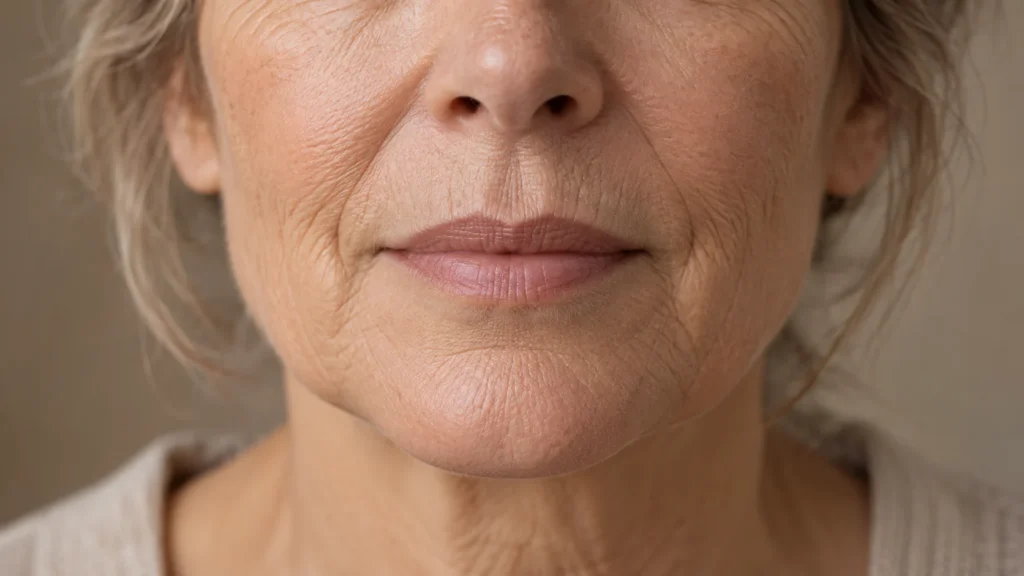
The accompanying close-up is an AI-generated illustration. It does not depict a patient or a lip treatment result.
Which part of the change are you noticing?
When you say that your upper lip looks smaller, I want to understand what you are pointing to. You might mean less visible red lip, a longer-looking area below the nose, or lines around the mouth. Those observations can be related, but they should not automatically lead to the same proposed treatment.
A useful consultation begins before choosing a procedure. I ask what has changed, what bothers you, and which features you would prefer to keep. You do not have to want fuller lips simply because you are discussing facial rejuvenation.
This article helps organize those questions. It is not a way to select an operation from a photograph or a measurement. I need to examine the region and discuss your priorities before deciding whether a change belongs in the broader facial plan.
Four features I consider separately
The skin-covered upper lip
I look at the area between the base of the nose and the red lip. A concern about its length is not identical to a wish for greater fullness. We need to be clear about which change you mean before discussing how it might be addressed.
The visible red lip
The red portion is often what people mean by “the lip” in everyday conversation. If it seems less apparent, I examine that impression in context instead of assuming that there is simply an empty area that needs filling.
Movement and the smile
I want to observe the mouth at rest and as you speak and smile. Expression belongs in planning from the beginning. If a feature of your smile is especially important to you, tell me so that we can discuss it explicitly.
Surface and border
Fine lines, the appearance of the border, and overall proportion are different concerns. Identifying the main priority helps avoid expecting a change in length or volume to resolve every aspect of the surrounding skin.
What the term upper lip includes
In a clinical explanation, the upper lip includes more than the red area alone. This matters when discussing length: a longer skin-covered segment does not mean the red portion is larger. If the terminology becomes confusing, I can point out the areas during the examination.
The central region below the nose is called the philtrum. It is part of the wider skin-covered upper lip, not a separate instruction about how much should be changed. I do not expect you to memorize the terminology or measure yourself before seeking advice.
It is often more productive to say “this distance seems different” or “I would like to understand why less of the red lip shows.” Those descriptions keep the conversation connected to your concern instead of making a technique name decide the answer in advance.
What an MRI study adds to the discussion
Ramaut and colleagues examined MRI scans from 200 people, comparing groups aged 20–30 and 65–80. Their 2019 study described differences in upper lip length and thickness and used a sectional area as a proxy for volume.1
It did not follow the same individuals over decades. The participants were described as Caucasian, and a sectional area is not a full three-dimensional volume reconstruction. I do not use the published differences to predict exactly how your own lip will change.
The practical lesson is to consider more than one dimension. An apparently smaller upper lip should not automatically be reduced to a question of adding volume. The study provides anatomical context; the treatment decision still needs your examination and goals.
Old photographs can clarify the question
An older photograph may help you show what feels familiar or what you believe has changed. It may also reveal that a feature has always been part of your appearance. I use that information to understand the conversation, not to promise a return to an exact earlier face.
Tell me when the difference is most noticeable. Is it at rest, in profile, when smiling, or with a particular expression? You may find that the concern is more specific than you initially thought. That is useful, even if you cannot yet explain the anatomy behind it.
I also consider how photographs were taken. Different expressions, positions, and distances can complicate a comparison. I would not decide the extent of a surgical change by treating two unrelated photographs as equivalent measurements.
Teeth and previous dental work belong in the history
When discussing the smile, I also want to understand the relationship with the teeth. Tell me about dental rehabilitation, dentures, orthodontic treatment, or a significant change that has occurred. If you have further dental work planned, include it in the conversation before we finalize a facial procedure.
I do not use one required amount of tooth display as a target for everyone. Your expression, preferences, and individual assessment matter. A measurement may contribute information without becoming an aesthetic rule that your face must meet.
If there is a dental concern, it needs discussion with the professional responsible for that care. I would not propose a lip operation as a substitute for evaluating it. Knowing the planned sequence helps us avoid treating the mouth as an isolated feature without relevant history.
Adding volume and changing length are different decisions
A request to make the lip larger may refer to projection, visibility, definition, or the distance below the nose. I try to clarify that meaning before recommending anything. Otherwise, the procedure and the expectation can end up answering different questions.
Fat grafting may form part of my facial planning, but I do not propose lip volume for every patient. Some people prefer a modest change; others do not want that characteristic altered. Those preferences should be heard rather than replaced by an assumption about what rejuvenation ought to look like.
I do not offer hyaluronic acid filler. I may discuss the distinction between adding volume and removing a strip of skin to explain the anatomy, but that explanation is not an offer of filler treatment or a suggestion that you should choose a treatment without assessment.
The lines around the mouth introduce another goal. I do not describe a lip lift as a procedure that will erase all of them. If texture is your main concern, we need to discuss that directly rather than use a change in proportion as a promise about the skin surface.
When I consider a lip lift
A lip lift can shorten the skin-covered upper lip in selected cases. Its place in a plan depends on examination, your priorities, and discussion of limitations and risks. I consider it only alongside facelift surgery in my practice, not as a standalone procedure.
A 2026 review included seven studies with 1,754 patients. It described changes in lip length and exposure after surgical lip lifting, but heterogeneity prevented meta-analysis.2 Those findings do not establish an ideal measurement for every face or remove the need to discuss scars, asymmetry, and possible revision.
Even when a facelift is already planned, a lip lift is not automatic. Ask why an associated procedure has been suggested and what it is intended to add. If it does not address your priority or its commitments do not make sense to you, that deserves discussion before any decision.
Previous procedures should not be left out
Tell me about fillers, surgery, and other treatment in the area, even if it happened some time ago. If you know the product or have records, bring the information. I prefer to work with the available history rather than assume everything visible is due to aging alone.
Do not try to reverse a previous treatment yourself in preparation for a consultation. We first need to understand what was performed and what you are noticing. If another assessment is appropriate, that can be discussed individually.
Mention discomfort, altered sensation, or functional concerns too. An appointment about appearance should not exclude them. They may change the questions that need to be answered before considering an aesthetic intervention.
Discussing the plan from another country
A video consultation can help us begin the conversation while you are abroad. You can show the area that concerns you and explain what you wish to preserve. I do not expect you to arrive with measurements or a predetermined operation.
The assessment must still be confirmed in person before surgery. A remote view does not provide every detail, and agreeing to explore an option online is not the same as finalizing an indication. I want that distinction understood before travel becomes a commitment you feel unable to reconsider.
The patient journey explains how the in-person appointment and follow-up fit into the visit. Bruna can help coordinate your initial contact. Questions about the specific lip plan belong in the clinical discussion, alongside the overall facelift proposal.
Questions that keep the goal clear
- Am I mainly concerned about length, visible red lip, fullness, or texture?
- Which part of my smile do I particularly want to preserve?
- What change would the proposed procedure address, and what would remain?
- Where would a scar be, and what limitations should I consider?
- Does my previous treatment or planned dental work affect the assessment?
You do not need confident answers before consulting me. These are starting points for a conversation. Saying that you cannot yet tell what has changed is more useful than selecting a procedure because its name seems to match a photograph.
Frequently asked questions
Are naturally thin lips a sign of aging?
Not necessarily. I do not treat a naturally understated lip as a problem in itself. Your history and preferences help us understand whether there has been a change and whether you want to address it.
Is there an ideal distance between the nose and upper lip?
I do not use a single number as a universal target. Measurements can support assessment, but they do not replace proportions, expression, preferences, or a discussion of treatment limitations.
Does everyone having a facelift need a lip lift?
No. It is a possible associated procedure in selected cases, not a required part of every facelift. You should understand the rationale for each component of your plan.
Will a lip lift remove all the lines around my mouth?
That is not a promise I make. If lines or texture are your primary concern, we need to discuss that objective separately and clarify what the proposed operation does not address.
Your expression should guide the conversation
If the mouth is part of what you want to discuss, bring it into your consultation even if you are unsure how to describe the change. You can contact Bruna to arrange an initial conversation from abroad. I want to understand both the concern and the features you value, so that any proposed association has a clear purpose within the facial plan.
References
- Ramaut L, Tonnard P, Verpaele A, Verstraete K, Blondeel P. Aging of the Upper Lip: Part I: A Retrospective Analysis of Metric Changes in Soft Tissue on Magnetic Resonance Imaging. Plastic and Reconstructive Surgery. 2019;143(2):440–446. doi:10.1097/PRS.0000000000005190. Age-group comparison, not individual longitudinal prediction.
- Komisarek O, Banasiak Ł, Olichwer V, Burduk P. The Bullhorn and Beyond: Evidence-Based Review and Clinical Recommendations for Lip Lift Techniques. Journal of Cosmetic Dermatology. 2026;25(3):e70703. doi:10.1111/jocd.70703. Heterogeneous studies; no pooled ideal measurement for individual patients.